Insight
Power Positions
When talking about power, we often think of ‘dominance.’ However, authentic power is having the ability to reach and influence rather than to impress or impose on others. Leaders who naturally have this kind of personal power are heard, followed and remembered for all the right reasons.
The key to achieving this leadership skill is:
 | Understanding your relationship to power - the good, the bad and the ugly |
 | Understanding when you are at your most powerful - the times when you are fully present and have the greatest impact on others |
From there, you can figure out how to achieve a balanced position to positively influence others.
Authentic Power
We can all think of a time when we wished we had felt more powerful in a difficult conversation or been more influential in a meeting. Instead of using our authentic power, we found ourselves at the ends of the spectrum, either by backing down unnecessarily or by raising our voice to make sure we were really heard.
Your most powerful position is when:
- You are relaxed, centered and holding your authority lightly
- Physically, your breathing is easy and complete as opposed to shallow and fast
- Mentally and emotionally, you find it easy to connect with and feel empathy for others; in return, you recognize they want to hear what you have to say
Because you are balanced within, you are both empowered and empowering.
And although the ideal Authentic Power is to be centered and Balanced, it’s important to recognize the other ends of the spectrum as well – Power Under, inferior energy, and Power Over, superior energy.
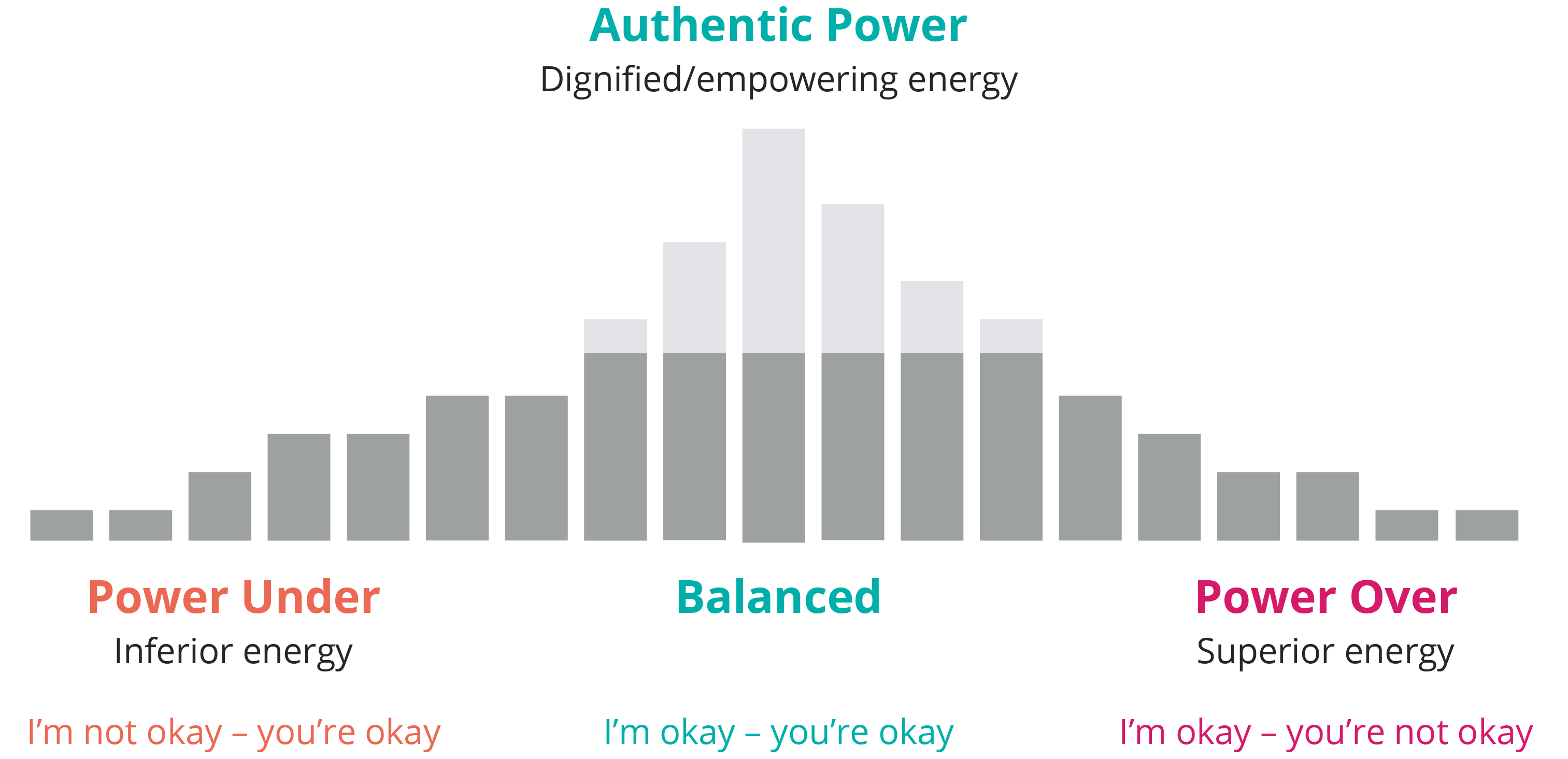
Here are some typical characteristics of each of these positions. Which characteristics do you recognize in yourself?
When you deny or contain your power, you may exhibit some of these signs:
- Withdrawing physically from people, feelings or ideas
- Holding your breath or rapid and shallow breathing
- You are asked to repeat yourself when you speak
- You are ignored and are not missed when you leave a room
- Feeling left out
- Feeling self-conscious
- Your energy is focused on yourself
- Having a softened voice
- Backing down or refraining from sharing your views
- Feeling nervous or unsure
- Your body language is closed and withdrawn
You may have expressed a Power Under position in the first months of a new role, under the influence of a domineering boss, or even at home with a spouse who tends to make the household decisions.
Your most powerful position is when you are relaxed, natural, feeling centered and holding your authority lightly. You may exhibit some of these signs:
- Feeling relaxed, natural, and centered
- Holding your authority lightly
- Breathing is easy and complete, not shallow and fast
- You find it easy to connect with others, build empathy, and others want to hear what you have to say
- You are open and willing to listen
- You are curious rather than judgmental
- Your attention is focused and energy is high
- Feeling balanced
- Feeling empowered and empowering
When you force your power onto others, you may exhibit some of these signs:
- You do not notice people you speak to or the room you are in
- Looking past people
- Taking command of discussions even if you have only heard a fragment of what is being discussed
- Noticing people withdrawing from you or making space for you
- Your attention is outside yourself, unfocused and lacking precision
- Having a loose connection to the situation
- Your energy is outward moving and non-specific (only in transmit mode)
- Fighting your corner when discussing ideas
- Your voice gets louder or stronger than others
- Feeling annoyed with others when they disagree or express different views
- Your body language is forward, even intimidating
You may have expressed a Power Over positions at an organization where you have significant tenure, with people you manage or with your spouse or children at home.
Depending on the situation, we may express each of the three power positions, but ultimately, both the Power Under and the Power Over positions are a loss in authentic power.
In the Power Under position, we dis-empower ourselves. | In the Power Over position, we dis-empower others. |
Therefore, having awareness of the times when you are in a balanced, authentic power state and the times when you are not is crucial to growing your effectiveness as a strong influencer. By having this self-awareness, you are then able to choose your authentic power position more often.